
Mattel Adds Doll to Collection
Last month Mattel added the Helen Keller doll as part of their Inspiring Women Series. She is the 12th doll among the great women in the collection such as Rosa Parks, Maya Angelou, Eleanor Roosevelt and Susan B. Anthony. The doll is dressed fashionably in a skirt and blouse. She is holding a book with molded braille on the cover which the national Federation of the Blind provided help and feedback. The doll looks very much like her except for the eyes which has stirred up some controversy. It is said that Keller had unilateral proptosis, which is the protrusion of one eye. This condition resulted in asymmetrical looking eyes. She was often photographed in profile or at an angle to cover up this fact.
Why the Controversy
Now, you might be asking what is all the hype about? What is the problem? Mattel decided to make a doll based on an extraordinary disabled American icon. Keller was an author, political activist and lecturer. She was also the first deafblind person to earn a Bachelor of Arts degree. She traveled all over the world. She met famous and important people. She fought for civil and human rights. She co-founded Helen Keller International, an organization initially for blinded WWI soldiers. She was outspoken and a feminist. She is inspiring and a great role model. So, designing a doll in her likeness sounds like a wonderful thing, right? Well, some say the issue is the doll is not accurate because her eyes look “natural” or “normal” whichever term you prefer. Some Disability advocates feel the doll should be a genuine representation of what Helen Keller really looked like. But I wonder about that.
Keller Took Portraits in Profile
Today is Helen Keller’s birthday and if she were still alive would she care the doll was not an accurate depiction? The reason I wonder is that she took pictures with her face not completely facing the camera. So that tells me she knew about her eyes. Maybe she was concerned about how they would look in a photo. Or maybe she was advised this was the best approach for a great picture. I have been there before myself. I have been told when taking pictures to adjust my smile and facial features. Sometimes I have been asked to remove my white cane from the shot and depending on the situation I do. It doesn’t mean I am ashamed of being blind it just means having my white cane in the picture is not always the best thing.
Wearing prosthetics
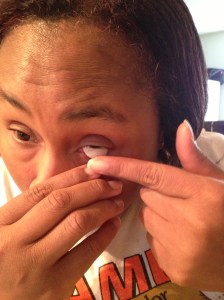
When Keller became an adult, she had her eyes removed and wore glass prosthetics. I also wear them too. They are ocular shells made of plastic. They are like large contact lenses laying on top of my eyeballs. My decision was totally cosmetic and a bit selfish. I just wanted to look and feel better. At the time I was wearing dark sunglasses because my eyeballs had receded and shrank making it hard for me to blink. So, it looked like I was sleeping constantly, and I was tired of my appearance and people questioning me about it.
In addition, I realized that wearing sunglasses, in some way, communicated to the world that I was ashamed of my eyes. The point was really driven home after attending a disability presentation called “Gawking, Gaping, Staring, Living in Marked Bodies” at Emory University. The presentation explored the history of how people with physical differences are treated in mainstream society. The presenter, Eli Clare, shared about how we must “cover up” our differences to be accepted. I realized that is exactly what I was doing with wearing the sunglasses. That night the shades came down both literally and figuratively. I was so deeply taken with this process I wrote a blog post about it called They Look So Real Wearing Ocular Lenses.
Creation of Barbie
Knowing the history of Mattel, I was not totally surprised with the creation of the Keller doll. I read a fascinating book titled Barbie and Ruth: The Story of the World’s Most Famous Doll and the Woman Who Created Her by Robin Girber. They were revolutionary in manufacturing Barbie. This doll was a real female with breasts, hips and thighs. During that time dolls were just round like balls and soft and cuddly. When Barbie came out parents were reluctant to purchase it, but little girls loved it because the doll allowed them to imagine being grown up. They could act like a real woman!
Explaining Disability Takes Energy
Critics said Mattel missed the mark and a teachable moment with the Keller doll. Keeping her eyes as they were would have been an opportunity to stay authentic and teach children about people who are different. Yes, I can see that, no pun intended. But I also see a doll with eyes that don’t look “normal” could be considered scary or uncomfortable to a child to look at or play with. Parents might not have the language to explain why the doll’s eyes look different. I deal with this stuff all the time as a grown woman, and it is hard. Constantly explaining my disability. How I live and move in the world. So, imagine a child? This is also partly the reason why many blind folks wear dark sunglasses. Getting back to what I said earlier when I wore them myself. We live in a world where differences are not easily accepted, and it takes a lot of work and energy. Sometimes you must decide how much of that energy you want to give. No judgement to my disabled readers. Also, it is about acceptance. Everyone wants to be loved and accepted. If “covering up” the disability will lead to that some people will do it. Or they might not want their disability to be a distraction or the focus. People just want to live and be.
Conflicted but Let’s Talk
I know this post might sound contradictory and all over the place. And it probably is. This topic is complicated in my opinion. It brings up many conflicting emotions for me. There is no quick and easy answer. However, one thing I clearly know, this doll has sparked conversation and that is a positive thing. We need to talk more and more about disability issues. Put things on the table and have open and honest dialogue. Push that big, loud pink elephant out of the room! Only then will we bridge understanding and acceptance. Then we won’t have to wonder about another doll and its representation of a disabled person.
Now, tell me what you think. Did Mattel miss the mark with this doll? Should they have created her with accuracy? If so, what do you think the reaction would have been?


 Empish J. Thomas
Leave a reply to hbsuefred Cancel reply