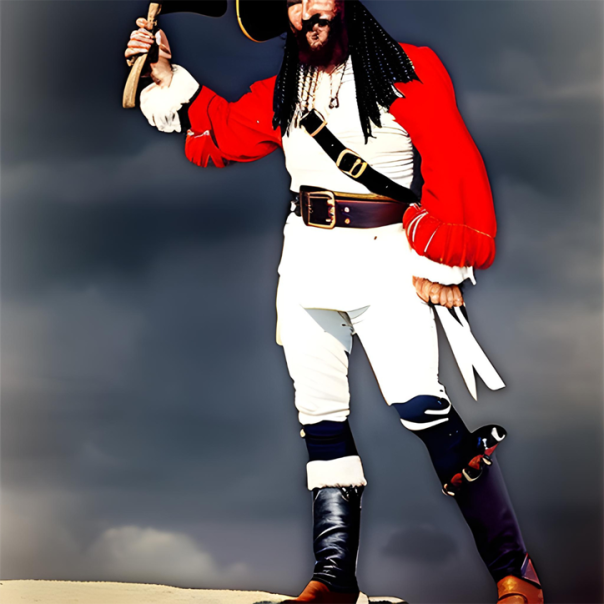
Ahoy matey! Blow me down and brush me barnacles. It’s time for a swashbuckling adventurous trip across the sea. This is my short, meager attempt to talk like a pirate. HaHa! Tuesday, September 19 is International Talk Like a Pirate Day. Since I can’t converse like a pirate I decided to focus on their disability instead.
Many images of pirates show an eyepatch, a hook replacing the hand or a wooden peg for a leg. As a Disabled person, it got me to thinking. How did they become disabled in the first place? Should we hold pirates up as heroes in the disability community?
How Pirates Became Disabled
So, I went down the internet rabbit hole to find answers to these two questions. First I read an article by The Guardian. The article explained how a pirate’s life was hard, dangerous and violent. There were no safety procedures on the ship. There was no governmental agency like the Occupation Safety and Health Administration (OSHA) to oversee the workplace. This hazardous work environment provided ample opportunities for accidents and injuries. Pirates used sharp swords, guns, cannons and gun powder. All of these instruments of battle could cause major injury.
Pirates Kept Working After Disability
Many pirates were former sailors who were wounded and discharged. But since their workplace was the sea, they continued to make a living through piracy. Their physical disabilities would invoke fear in their victims. This fear was an advantage because the more ruthless they appeared, the bigger their chance of success. This rings true. If you think about Long John Silver in the book, “Treasure Island” or Captain Hook in Peter Pan. They were villains in these fictional stories but based on real pirates.

These pirates kept working after becoming disabled. Although their career was a bad one, they did live and work. They figured out how to keep going with a disability. If an accommodation or other meaningful and honest work were available would we have pirates at all? If you remove the awful parts of the job, these elements can be viewed as somewhat aspirational.
They used adaptive aids of their time. Things found easily on a ship like iron and wood. Of course, prosthetic limbs are more advanced now than hooks or peg legs. Eyepatches covered up damaged or missing eyes. There were no sunglasses or prosthetic eyeballs. I wear ocular lenses made from plastic and those didn’t exist either.

Disabled People Do Bad Things Too
Now, let’s think about this. A disability doesn’t automatically make a person do terrible things. Perhaps the desire was already there in the first place. This is a point my blind friends and I discuss often. We will hear about a blind person doing something wrong and sighted people reacting with shock. We know this is ablism because blindness is not the issue. All people, disabled or not, have the ability to do bad things
When you think of a pirate their cruel nature is more prominent than their disability. Why is that? Do we shutter to think that a disabled person would be so cold and heartless? As a blind person, do I want to associate with an image like that? Especially when we already struggle with accurate depictions in the first place?
These questions got me thinking. If we want society to accept our disability, and that we are human beings. Then shouldn’t we embrace the good with the bad? Blind and low vision people can do bad things. We can cause harm to others. We are not all perfect. We are not all law abiding citizens. We are flawed and not innocent angels that do no wrong. Well, isn’t that a pirate too? But in all fairness, the problem lies in the pirate being the only or most prominent representation of a disabled person. We need to see both good and bad disabled people and not just stereotypes.
Final Thoughts

So, here are my final thoughts. As Yes! Magazine explains we need pirates. We need a diversity of images of the disabled. Portraying the good, bad and ugly shows the complexity of humanity. Life of the disabled is not always black and white, there are shades of grey and I think pirates are an example of that.


 Empish J. Thomas
Leave a comment